
Helping a child learn English... and 96 other languages: listen, speak and laugh a lot
Listen, speak and laugh: help a child learn English and explore 96 other languages without turning it into homework.
Tuesday, 7pm. A voice from the living room: "Compagnon, how do you say 'I didn't mean to' in English?" Then: "And in Japanese?" Then: "And in Swahili?" You're draining the pasta, and you've just witnessed something precious. A desire to learn that comes neither from a workbook nor from a test. Just from a question. Because to learn English, a child doesn't only need lessons. They need to want to. And sometimes, that desire starts with Japanese.
English from the first year of school, and yet...
Since the 2016 school year, every French pupil has learned a modern language from the very first year of primary school. In the vast majority of primary schools, that language is English. It continues in secondary school, and a second language arrives in Year 8.
On paper, a child starting secondary school already has several years of English behind them. And yet many parents notice the same thing: they know their vocabulary lists, they do well in written exercises... but as soon as they have to speak, they freeze.
It isn't a lack of work, or a lack of talent. It's often a question of order.
To learn English, a child first needs to hear it
Think back to how your child learned their first language. They heard it first, thousands of times. Then they tried to say it, clumsily, until it came out on its own. Reading and writing came years later.
With English, the order is often reversed: word lists, irregular verbs, sentences to copy out. All of this is useful, and we regularly write about it in our articles on school learning. But a step is missing.
A language you've never heard remains a language you don't dare to speak.
That's the whole point of Compagnon, the knowledge box for 8 to 15 year olds: all it does is talk. The child asks their question out loud, hears the answer, repeats it. Then starts again. In English, and in 96 other languages. It's simple, and it's exactly how they learned to speak.
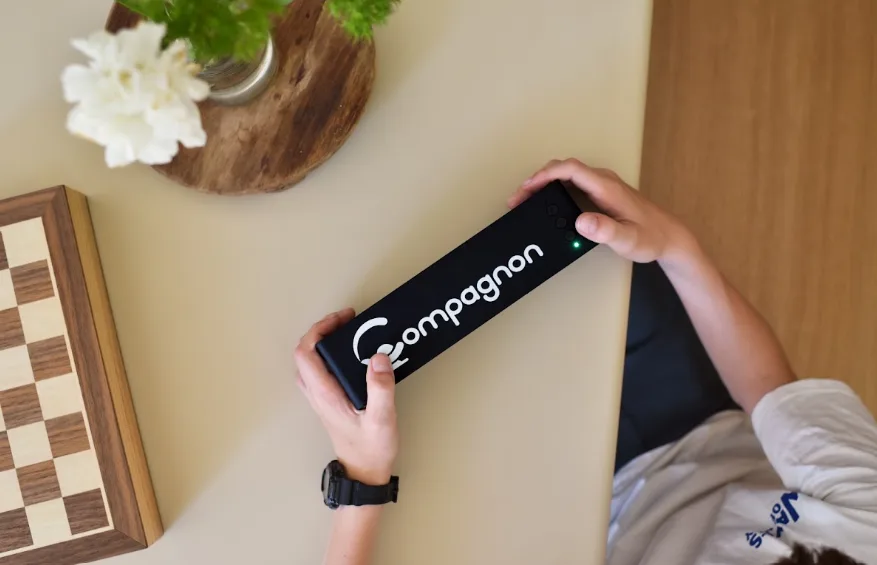
The right accent, from the very first word, in 97 languages
Who hasn't discovered, as an adult, that they'd been mispronouncing an English word for years? A word misheard the first time sticks, and then has to be unlearned.
English is full of traps: "squirrel", "comfortable", "Wednesday", where some of the letters aren't pronounced. Not to mention "th", a sound that doesn't exist in French and that so many pupils turn into a "z".
When Compagnon answers in English, it pronounces things properly. And the same goes for Spanish, German, Japanese or Arabic. The child hears the right music from the start: the stress, the unfamiliar sounds, the way a sentence rises or falls. They won't have to unlearn anything later.
A private tutor with all the time in the world
Many English teachers know this scene. The pupil knows. They have the answer in their head. But they won't say it out loud, because they'd have to pronounce it in front of the whole class. The fear of getting it wrong in front of others is stronger than the desire to take part. This block is especially common when starting secondary school, at the age when other people's opinions weigh more and more heavily.
The remedy is being able to practise without an audience.
Compagnon can quiz them on their vocabulary, have them repeat a sentence, help them practise introducing themselves before an oral test. As many times as needed, without ever losing patience. Alone in their room, they can make mistakes, laugh at themselves and try again. And it's often after making lots of mistakes away from prying eyes that they finally dare to speak up in class.
A tip, by the way: when your child gives English a go in front of you and makes a mistake, avoid correcting every word. Simply repeat the sentence correctly, as you did when they were little. They'll hear the right version without feeling caught out.
97 languages to travel the world from their bedroom
There are more than 7,000 languages spoken in the world today, according to Ethnologue, the reference catalogue. With Compagnon, a child can explore 97 of them.
Saying hello in Swahili. Counting to ten in Korean. Discovering that in German, a little box of matches is called a "Streichholzschächtelchen", and that in Icelandic, a cat is a "köttur". Every word is a little door opening onto a country and another way of naming things. And one question leads to another: "Where do they speak this language?" "Why do they have a word for that and we don't?"
Words travel, just like traditions. Halloween, for example, left Ireland before coming back to us from America. And sometimes, you don't need to cross a border to stop understanding each other: just listen to a teenager shouting "six-seven" in the living room.
This curiosity helps with English too. A child who has fun discovering words in Japanese understands something essential: a language isn't just a school subject. It's a door opening onto the world. And English becomes one of those doors, rather than a chore.
And we laugh, a lot
"Say 'my brother has smelly feet' in Italian." "Tell me a joke in English." "Say it again in Chinese, but slower."
Children love getting Compagnon to speak every language. They test it, they have fun, they challenge their brothers and sisters. It could pass for a simple game.
It isn't one. A word learned during a fit of giggles is very likely to stick. And above all, a child who has fun with a language wants to come back to it. Before speaking English well, you have to want to speak it.
Seven ideas to get started at home
Help them revise differently. The night before the English test, instead of testing them on their list yourself, let them ask: "Compagnon, quiz me on words for the house in English." They practise on their own, and you check at the end. That's one less source of tension in the evening.
Help them practise introducing themselves. It's often the first oral exercise in secondary school. They ask Compagnon how to say their age, their hobbies and their family in English, then practise putting it all together out loud. The day the teacher calls on them, the sentence is already in their ear.
Start a word of the day at dinner. Every evening, someone picks a word and a language: "How do you say 'enjoy your meal' in Japanese?" Everyone repeats it before starting to eat. And if you love dinner-time rituals, our monthly newsletter offers a true story to tell at the table.
Launch the "one language a week" challenge. On Monday, pick one of the 97 languages. By Sunday, they need to be able to say hello and thank you, count to ten and introduce themselves. A little chart on the fridge keeps track of the languages already "conquered".
Speak the family language. A Portuguese grandmother, a Polish uncle, a godmother living in Germany? Prepare a message together in their language for the next call. Guaranteed effect, on both sides.
Hold an impossible-word contest. "Squirrel", "Worcestershire", "Streichholzschächtelchen"... Everyone suggests the hardest word they know, Compagnon gives the correct pronunciation, and the whole family has a go.
Translate the most absurd sentence. They invent the strangest sentence possible and have it translated into English, then into four other languages. "The giraffe forgot its glasses." Giggles guaranteed, and a few words remembered along the way.
What it really changes
For a child, learning English isn't just memorising lists. It's hearing before writing, daring to speak before feeling sure, making mistakes and trying again. And it's discovering, along the way, that other people see the world differently.
Compagnon doesn't aim to replace the English teacher. It offers something else: a place where children can practise freely, ask every question, even the wackiest ones, in 97 languages, and develop a taste for languages before they even realise they're learning.