
Homework Without Battles: 4 Ways to Help Kids Learn
Compagnon
Four practical ways to make homework time calmer, build independent study habits and help your child without doing the work for them.
"Did you study your lesson?" "Did you understand the exercise?" "Seriously, what is 7 × 7?" If these phrases echo through your home almost every evening, you know the drill. A tired child, an equally exhausted parent, explanations that go in circles... and sometimes, just so everyone can finally sit down for dinner, the answer whispered under your breath. Rest assured: homework help doesn't have to be a daily tug-of-war. It mostly comes down to a few good keys.
In Brief
Truly helping your child with homework doesn't mean doing the exercises with them, let alone doing them for them: it means helping them understand what is being asked and guiding them to find the path to the answer on their own. Four keys are all it takes to soothe most evenings: a real break between school and study time (a buffer zone), a consistent ritual, tasks broken down into small steps, and questions rather than answers. Good to know: in French primary schools, written homework has been officially prohibited since 1956; evening work is normally limited to reviewing lessons and oral practice.
Why Does Homework Time Turn into a Battle So Often?
Because it comes at the worst possible time of day. After a full day in class, your child has already given their all. On your end, you have to juggle dinner, school messages, and tossing in a load of laundry. Homework gets squeezed into the one window where no one really has any energy left.
On top of that exhaustion come less obvious hurdles. Your child might have understood the lesson perfectly in class, surrounded by their teacher and classmates, only to find themselves completely stuck once they are alone in front of the very same exercise. Some children are so afraid of making mistakes that they prefer waiting for someone to hand them the answer rather than risking an error. Others simply don't know where to start: organizing their work, studying a lesson, planning ahead for a test—these are all skills that have to be learned, too.
And then there is the pressure. When homework time turns into a barrage of reminders, "hurry ups," and heavy sighs, the joy of learning evaporates in a flash. On both sides of the table.
The first step is therefore a shift in perspective. Homework isn't a checklist to tick off as fast as possible. It is the moment where your child learns, step by step, how to work without you.
Homework Help in Primary and Middle School: What the French School System Actually Says
First, a piece of information that surprises many parents: in French primary school, written homework at home is actually prohibited. An official ministerial circular dated December 29, 1956, specifies that no written homework, whether mandatory or optional, should be assigned to pupils outside the classroom. This rule has been reaffirmed several times since, notably in a circular on September 6, 1994: after school, assigned work is strictly limited to oral work or studying lessons.
In reality, many children still bring written exercises home. But keeping this rule in mind changes the way you approach evenings in CE2 (Year 4, age 8-9), CM1 (Year 5, age 9-10), or CM2 (Year 6, age 10-11). At this age, the bulk of home study is about rereading, memorizing, and practicing aloud. In other words: understanding and retaining, far more than producing.
In collège (middle school), everything scales up. Independent study takes center stage, subjects multiply, and study methods become a subject of their own. This is also when many parents admit to losing track of the curriculum. Who really remembers the intricacies of Thales' theorem or the agreement of tenses? With foreign languages too, helping at home takes on a different shape: for English, for instance, hearing the language and daring to speak it matters just as much as reciting vocabulary lists, as we explained in our tips for helping a child learn English.
To support middle schoolers, the French Ministry of National Education launched the Devoirs faits ("Homework Done") initiative in November 2017: a free, supervised study period organized at the school outside of class hours. Since the start of the 2023 school year, it has been mandatory for all 6e (Year 7, age 11-12) students; for other grade levels, each school sets its own terms. Check with your child's middle school: it is a valuable support system that nicely complements what happens at home.
How Can You Help Your Child Become Independent with Homework? The 4 Keys
Independence doesn't mean leaving your child to struggle on their own. It means giving them a reassuring framework, simple habits, and the freedom to search for an answer themselves before someone steps in. Here are the four keys that make all the difference, adaptable to each child's age and personality.
Key #1: create a buffer zone between school and study time.
Before pulling out the notebooks, give your child time to have a snack, move around, play, or tell you about their day. During this buffer zone, no questions about lessons. This genuine break helps them transition from the school rhythm to the home rhythm, returning to their work with renewed energy. There is no single ideal length of time: an 8-year-old coming home from a packed day doesn't have the same needs as a 14-year-old middle schooler.
Key #2: establish a ritual.
A quiet space, supplies within arm's reach, a fairly consistent order of work: a set ritual removes most of the negotiations. You no longer need to argue about whether homework will get done, nor when, nor where. For instance, you might start with the shortest exercise to build momentum, move on to the task that demands the most concentration, and finish by packing the school bag. In middle school, gradually let your child design their own ritual: that in itself is a step toward independence.
Key #3: break down the work into small steps.
Faced with a long list of homework, a child can quickly feel overwhelmed. Help them break it down: reread the instructions, rephrase them in their own words, complete a first exercise, and then move on to the next. Every step taken is visible progress, and the mountain suddenly looks far less daunting. For a middle schooler, the same logic applies across the entire week: preparing for a Friday test is best done in three short study sessions rather than one panicked evening.
Key #4: ask questions rather than giving answers.
This is undoubtedly the most important key—and the hardest to stick to when it's getting late. Instead of saying "The answer is 49," try:
- "What do you already know about your times tables?"
- "Do you remember doing an exercise similar to this one?"
- "What is the question asking you to find, exactly?"
- "How do you think you could tackle this?"
This approach has a very old name: maieutics, the method used by the philosopher Socrates, who helped people give birth to their own ideas through the power of questioning. Prompting them to think without giving away the answer is exactly that. By asking questions, you help your child draw upon what they already know and build their own line of reasoning. And an answer discovered on one's own is remembered much better than one whispered in a hurry.
How to Get Homework Done Without Losing Your Temper
By keeping in mind that the goal isn't just to finish, but to understand. And by giving yourself permission to pass the torch. A few simple reflexes can truly help you stay calm, even on a bleak Tuesday evening in November.
Have them rephrase the instructions.
When your child gets stuck, ask them to explain what is expected of them in their own words. Very often, the roadblock doesn't stem from the concept, but from the wording of the prompt itself. Simply rephrasing it aloud is sometimes enough to unlock the solution.
Praise the effort as much as the result.
"You searched for a long time, and you found a great lead" is often worth much more than "That's correct." A child who feels their efforts are valued will be more daring next time, even when the work is tough.
Make room for mistakes.
A mistake isn't a disaster: it's valuable information. It shows the teacher what hasn't quite clicked yet. There is no need to correct every little thing behind your child; instead, guide them to spot where they went off track on their own.
Know when to stop.
When exhaustion takes over and every extra minute leads to tears, it is far better to stop. A quick note to the teacher mentioning the difficulty will be much more constructive than an hour-long battle.
Pass the torch when you can.
The Devoirs faits program in middle school, another adult in the family, a tool designed specifically to support children: delegating part of the homework routine is by no means an admission of failure. It is often the very thing that preserves your relationship with your child.
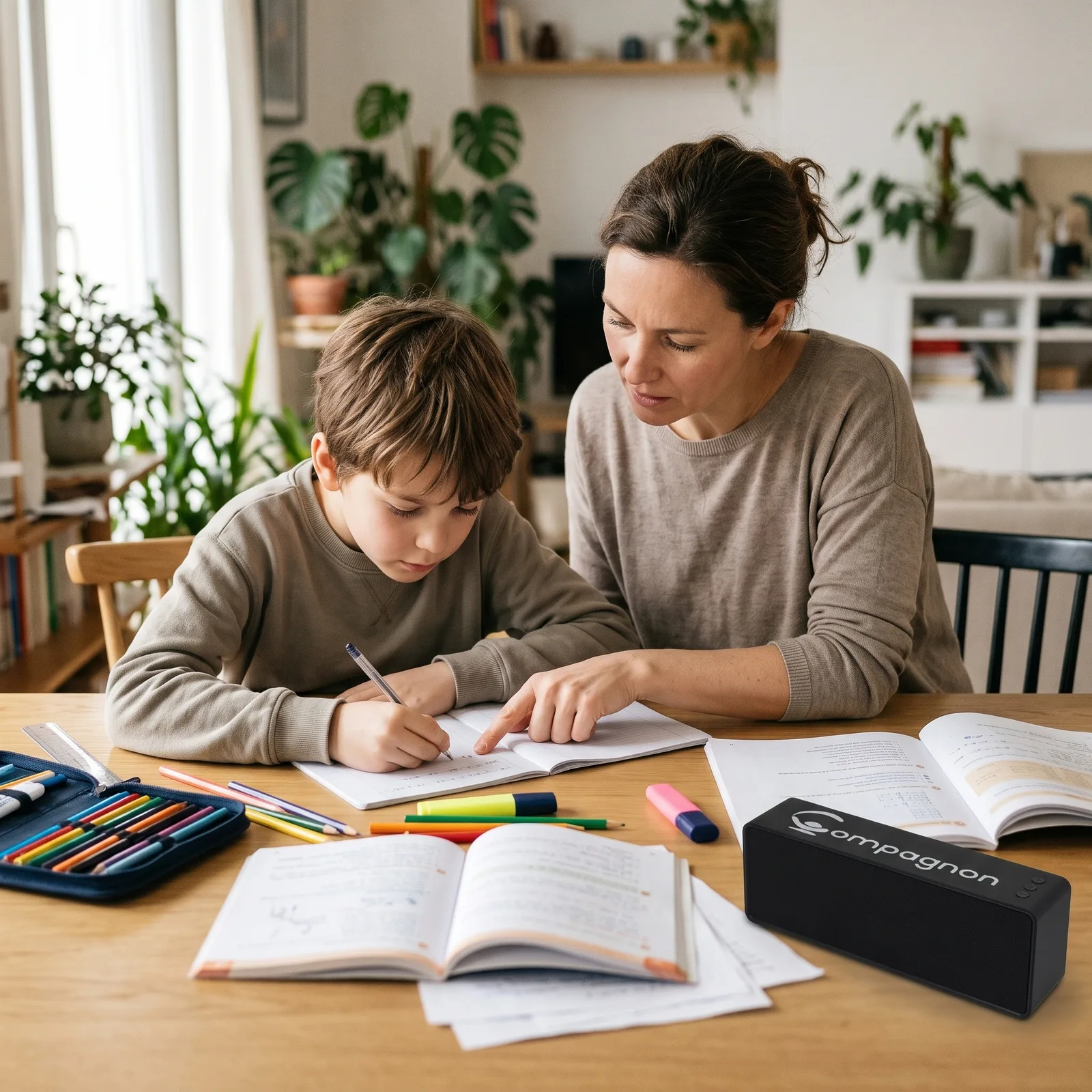
Ready-Made Answers: The Hidden Trap of Homework
An answer obtained in a few seconds teaches a child next to nothing if they haven't done the mental legwork to get there. That is the main danger of solutions available at the click of a button.
Today, a quick internet search or a prompt typed into a mainstream AI tool on a smartphone or tablet can churn out a complete, fully written answer. The temptation to just copy it down is huge, especially when you're tired and the assignment is due tomorrow. Not to mention the notifications and distracting apps waiting right alongside it.
The problem isn't the tool itself, but how it is designed and used. Genuinely helpful homework support should empower a child to:
- ask questions freely, even the ones they feel too shy to ask in class;
- receive explanations tailored to their age and grade level;
- think things through before receiving the answer;
- progress at their own pace;
- understand, rather than simply copy a ready-made solution.
In other words, great homework help puts Key #4 into practice: it guides through questions.
Guiding Through Questions Rather Than Handing Out Solutions: The Compagnon Approach
This is the exact mindset we nurture at Compagnon.
Compagnon is the screen-free voice "knowledge box" designed for kids aged 8 to 15. The child asks their question out loud and receives an age-appropriate answer within a secure environment featuring full parental control. Developed in France, Compagnon is the natural next step after screen-free storytellers.
Originally, Compagnon was created to answer all the "whys": every curious question that pops into a child's head, from the most profound to the most whimsical. Over 100,000 questions have already been asked. Today, a new version goes even further, providing personalized homework support tailored to your child's age, grade level, and learning style. Covering all subjects and all homework assignments, from primary school through middle school. And because every child learns differently, Compagnon adapts to all profiles: children with ADHD, learning differences (dyslexia, dyscalculia, dyspraxia), ASD, gifted and twice-exceptional learners... and everyone in between.
One rule never changes: Compagnon never does the homework for the child. It helps break down the instructions, encourages them, and guides them step by step until they find the answer on their own. That makes all the difference between handing over a solution and helping a child genuinely understand.
For parents, it serves as a welcome helper on busy evenings, easing your mental load without leaving you out of the loop: you stay in control of settings through the parental controls.
What If the Most Important Thing Wasn't Finishing Fast?
There is no magic wand to make homework go perfectly every single night. But a few simple habits can truly transform your evening atmosphere: respecting your child's rhythm, providing a clear routine, encouraging curiosity, and celebrating effort just as much as results.
Independence isn't built in a single night. It grows every time a child makes sense of a prompt, solves a problem, or masters a lesson without waiting for someone to feed them the answer. And along with it, their self-confidence flourishes.
Because deep down, the best part of homework isn't closing the books. It's that moment when your child looks up with a grin and says: "I get it now!"
Want your child to find their own answers without evening battles? Ask Compagnon.
FAQ: Parents' Questions About Homework Help
How long should homework take in primary school and middle school?
There is no single official duration. In French primary schools, written homework has been prohibited since the circular of December 29, 1956: evening work is normally limited to reviewing lessons and oral practice, meaning short sessions. In collège (middle school), independent study time increases with the number of subjects and varies by grade and teacher. In any case, focused, regular study is far more effective than a drawn-out session dragging on when fatigue sets in.
My child refuses to start their homework: what should I do first?
Start by making sure they have had a real break since returning from school: an exhausted child often resists out of fatigue rather than defiance. Next, invite them to choose which assignment to tackle first, suggesting the shortest one. Giving your child a say in the decision reduces pushback and helps them get the ball rolling.
Should I correct all of my child's mistakes?
No. Homework also serves to show the teacher what has not yet been mastered: correcting everything at home conceals these learning gaps. It is better to help your child spot their own mistakes ("Reread that sentence: does anything look off to you?") and let the teacher see where they truly stand.
How can AI be used educationally for homework?
An artificial intelligence tool can help a child understand a concept or receive an alternative explanation, provided it isn't used to generate answers directly. The golden rule: the child should try on their own first, then use the tool to check their reasoning or get unstuck on a specific step, never to copy-paste a solution. A truly educational tool asks questions and guides step by step rather than simply handing over the answer.
What is the "Devoirs faits" program in French middle schools?
Devoirs faits ("Homework Done") is a free, supervised study period organized at middle school outside of class hours, launched by the French Ministry of National Education in November 2017. Since the start of the 2023 school year, it has been mandatory for all 6e (Year 7, age 11-12) pupils. For other grade levels, each school decides on its own arrangements: check directly with your child's middle school.
What is the difference between a storyteller and a knowledge box?
A storyteller box primarily lets children listen to stories and pre-recorded audio tracks. A knowledge box, like Compagnon, allows children to ask their own questions out loud to explore, understand, and learn. Compagnon is designed for children aged 8 to 15 and also offers personalized homework guidance.
Sources
- Circular of December 29, 1956, regarding the abolition of written homework in primary education (French Ministry of National Education).
- Circular No. 94-226 of September 6, 1994 (homework limited to oral work and studying lessons).
- French Ministry of National Education, éduscol: "Devoirs faits, un temps dédié pour accompagner les collégiens dans la réalisation de leurs devoirs" (mandatory in 6e since the 2023 school year).
- French Ministry of National Education, education.gouv.fr: "Devoirs faits : un temps d'étude accompagnée pour réaliser les devoirs" (implemented in 2017).