
How to Plan a Kids’ Birthday Party at Home (8–12)
Compagnon
Plan a birthday party at home for kids aged 8–12, with age-appropriate games, simple activities and a schedule that keeps everyone happy.
Between the ages of 8 and 12, birthday parties take on a whole new look. Balloons and magicians just don't cut it anymore. Your child wants a real party with their friends, a challenge to tackle, and that little bit of pride that comes with hosting at their own place. And you are left wondering how to keep eight kids entertained for three hours without turning the living room into a battlefield.
Here is the good news: hosting a birthday party at home at this age is often simpler than with younger children. Kids are independent, they love being trusted with a mission, and a single great activity can carry the entire afternoon. The secret comes down to three things: a clear structure, a well-paced schedule, and a headline activity that gets them problem-solving together.
Here is how to make it happen, step by step.
Before the party: setting the framework
Choosing the date and duration
Wednesday afternoons and Saturdays remain the top choices. For a party at home, plan for 2.5 to 3 hours: just enough time to play, have birthday cake, and open presents, but not long enough for overtiredness to set in. A classic time slot like 2:30 p.m. to 5:30 p.m. also gives parents plenty of time to pick up their children without rushing.
Send out the invitations two to three weeks in advance, making sure the end time is clearly stated. It might seem like a small detail, but it will keep you from finding three guests still lounging on your sofa at 7:00 p.m.
How many guests?
A simple rule of thumb often works best: invite as many guests as your child's age, or slightly fewer. At home, a group of 6 to 10 kids can easily be managed by one or two adults. Beyond that, everything gets much trickier: the noise, the space, and the little cliques that start to form.
Let your child make their guest list, then sit down and review it together. Around age 10, friendships shift quickly, and it is best to avoid having a friend feel left out at the last minute.
Finding a theme that suits them
This is often where the party comes to life. Pirates, detectives, adventurers, ancient Egypt, secret agents… The theme sets the tone for the invitations, the decorations, and especially the main activity.
The best approach: let your child choose. At this age, they know exactly what they like, and they will be all the prouder of their party if it truly reflects who they are. You can even draw inspiration from one of their current passions, or a question they asked you recently ("How did people actually make mummies?"), and turn it into the central theme.
Prepping the space
There is no need to overhaul the entire house. Pick one room for playing, one for snacks and cake, and close the doors to the rest. Put away anything fragile, clear the floor, and set up a spot for coats and gifts. If you have a garden, treat it as a bonus: part of the activity can take place outside if the weather is nice.
On the big day: a schedule that works
Birthday parties that get out of hand are usually the ones where kids are left waiting around with nothing to do. Having a simple schedule mapped out in your head (or scribbled on a sticky note) makes all the difference.
| Time | Duration | What's happening |
|---|---|---|
| Welcome | 15–20 min | Guests arrive, a quick free-play game while waiting |
| Headline activity | 60–75 min | Treasure hunt, mystery investigation, or escape game |
| Snack & cake | 30 min | Cake, candles, drinks |
| Gifts | 20 min | Opening presents together |
| Free play & pickup | 20–30 min | A quick game while waiting for parents |
For the arrival phase, plan an easy icebreaker that doesn't require everyone to be there at once: a quiz sheet to fill out, a collaborative drawing, or a riddle to solve. Early arrivals won't get bored, and latecomers can jump right in as they arrive.
The headline activity: getting them to search together
This is what creates lasting memories. Between 8 and 12 years old, kids love being given a mission: solving a riddle, cracking a code, or finding a hidden treasure before time runs out. They search, they debate, they make mistakes, and they try again. And when they finally crack it, the whole team celebrates together.
The treasure hunt: a foolproof classic
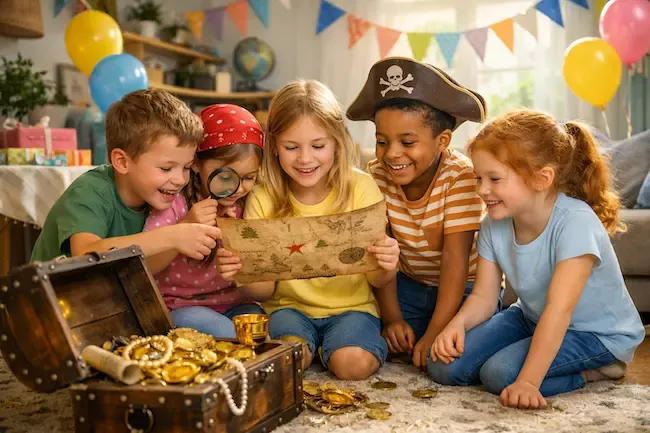
It works for every age, as long as you match the challenge to their level. Around 8–9 years old, children can read on their own and enjoy multi-step puzzles. The premise is simple: a starting story, clues hidden around the house, each leading to the next, all the way to the final treasure.
You can create everything yourself from scratch, but that is often how prep nights end up stretching into the early hours. To save time, Un Anniversaire en Or offers printable birthday treasure hunts organised by age group. Each kit includes a storyline, puzzles, clues, and an adult guide: just print, hide the clues, and the mission is ready to launch. Created in 2013 by Laure Lucbert, a State-certified early childhood educator and mother of three boys, these games are carefully tailored to each age group's skills.
The investigation: for budding detectives
An object has gone missing, a mystery hangs over the party: the guests step into the shoes of detectives. They interview suspects, cross-reference clues, and rule out leads. Investigations are especially popular with kids who love logic and debate, and they encourage the group to really listen to one another.
The escape game: for 10-to-12-year-olds
From age 10 onward, an escape game is often the top favourite. The setup: a countdown timer, a series of puzzles to solve in order, and padlocks to crack. The ticking clock adds an exciting burst of adrenaline that tweens love. If you have a larger group, consider splitting the guests into two teams so everyone gets an active role.
Little secrets for a successful activity
- Test a puzzle or two before the big day to make sure the difficulty level hits the sweet spot.
- Keep a backup clue in your pocket in case the group gets stuck for too long.
- Give everyone a specific job: clue reader, map keeper, code breaker. That way, no one feels left out.
- Slip general knowledge questions into the riddles. Kids love showing off what they know, and it is a wonderful opportunity to draw from our trivia quizzes for 8-12 year olds.
Snacks, gifts, and handling the unexpected
A simple, fuss-free snack time
After an hour of investigating, kids are hungry, but they eat quickly. There is no need for an elaborate spread: a cake, some sliced fruit, and drinks are more than enough. Remember to ask in advance if any guests have food allergies or dietary restrictions. And if it fits the theme, a fun decorative touch on the cake (a treasure map, a detective's magnifying glass) always goes down a treat.
Present opening: keep it structured
Opening presents together gives every guest the chance to see their surprise appreciated. Encourage your child to thank each friend as they unwrap their gift: it is a simple gesture, but it means a lot. When it is time to say goodbye, a small favour bag with a little treat or a keepsake from the mission (a detective certificate, a piece of the "treasure") keeps the magic going a little longer.
Common hiccups and how to handle them
- A guest who is pouting or doesn't want to play: give them a special role, such as timekeeper or clue guardian.
- A puzzle that is too hard: use your backup clue or offer a gentle, discreet nudge.
- A group that finishes too quickly: keep a short backup game handy, like a quick quiz or charades.
- Late-afternoon fatigue: wrap up with a calm, seated activity, like a story or a riddle, while waiting for parents to arrive.
The best gift: a party made just for them
A great birthday party at home doesn't have to be picture-perfect. It is simply a party where your child feels like the star of the show, surrounded by good friends, tackling a challenge they worked through together. Years down the road, that is what they will remember: the day they tracked down the treasure, cracked the case, or unlocked the final padlock with ten seconds left on the clock.
And if the party sparked brand-new questions ("Did pirates really bury their treasure?"), even better. Your child can keep the adventure going by asking their knowledge box.