
Lookiz, Mallow, Compagnon: the new story boxes no longer just tell stories
Ary by Lookiz, Mallow, Compagnon. Three screen-free devices, powered by voice, three different ways of supporting a child. Here is how to make sense of them.
For ten years, the story box was the bedtime ritual in thousands of French homes. It told the story, the child listened. Over the past few months, a new generation of devices has been arriving on the market with a simple yet profound idea: what if the child could finally answer back? Ary by Lookiz, Mallow, Compagnon. Three screen-free devices, powered by voice, three different ways of supporting a child. Here is how to make sense of them.
The night the story box could not answer
It is bedtime. Your child is 8, knows every story on the box by heart, and tonight, in the middle of the story, asks: "But why does the wolf want to eat the grandmother?" The box simply carries on with its story. It was never designed to hear the question.
That is often where everything happens. Around the age of 8 or 9, a child no longer just wants to listen: they want to understand, discuss, check, ask again. The "whys" pile up, at dinner, in the car, during homework, just as the light goes off. And the story box, which fed their imagination so well, cannot keep up.
The story box achieved something remarkable: it proved to parents that a device could keep a child busy, enrich them and calm them without a screen. It built trust. The next step remained: moving from listening to conversation.
Over the past few months, the boxes have started talking with children
That is exactly what the devices recently launched on the market offer. What they have in common: the voice travels both ways. The child no longer just presses a button to play content chosen in advance, they ask their own question and get an answer suited to their age.
At Lookiz, this takes the form of a plush toy, Ary, which tells personalized stories and answers questions from 3 to 12 year olds. Mallow starts from a strong belief: a child's voice is their "superpower" and every game should make them an actor rather than a spectator. Finally, Compagnon presents itself as a knowledge box for 8 to 15 year olds, designed to take over from story boxes at the point when questions become more numerous and more demanding.
Three devices, three audiences, one shared intuition: a child does not need one more screen to learn. They need someone to answer them.
Why voice, and why now
Look around you. We dictate our messages, send voice notes instead of long texts, listen to podcasts while cooking, ask for directions without taking our eyes off the road. In just a few years, voice has once again become a natural way to access information. Not a trend: a return to the oldest and most intuitive form of communication there is.
For a child, this is even more true. They speak years before they can read, and long before they can type on a keyboard. Using voice means giving them access to knowledge through the tool they master best, without the filter of writing or of an interface. All their attention goes to the idea, not to whatever is flashing around it.
Research in cognitive psychology points the same way. The work of Colin MacLeod, at the University of Waterloo in Canada, highlighted what researchers call the "production effect": we remember information we say out loud better than information we read silently. Reciting a lesson, rephrasing an explanation, answering a question: speaking is already memorizing.
Schools have clearly understood this. Oral skills have taken a growing place in students' education, to the point of becoming a full exam in its own right at the brevet (the French middle school diploma), and then at the baccalaureate with the Grand oral since 2021. Knowing how to put your thoughts into words, organize them and defend them out loud is no longer a bonus: it is an assessed skill.
Finally, there is the question every parent of a 10 or 11 year old asks: what about the smartphone? In 2024, the expert commission on children's exposure to screens, commissioned by the French presidency, recommended not giving a child a phone before age 11, nor an internet-connected smartphone before age 13. Between the story box and the first smartphone, there are therefore several years during which a child wants independence, without their parents wanting to put the web in their pocket. Voice devices fill precisely that space.
What voice really changes for a child
Beyond the absence of a screen, talking with a device that answers transforms the way a child learns. Three things change.
First, they learn to ask questions. It seems obvious, and yet it is a skill in its own right. Asking a question already means identifying what you do not understand, choosing your words, sharpening your thinking. A child who asks ten questions a day is, without knowing it, practicing how to think.
Next, they gain independence and confidence. When the answer is available the moment the question comes up, the child no longer has to wait for an adult to be free, or give up for lack of an answer. They search, they understand, they move forward on their own. And the pride of getting there by themselves is worth every reward.
Finally, they stay in the real world. Voice frees the eyes and the hands. You can ask a question while drawing, cooking, tidying your room, looking out of the car window. Learning slips into everyday life instead of interrupting it.
Three devices, three ages, three philosophies
Ary by Lookiz: the plush toy that tells stories and answers
Ary is an interactive plush toy for children aged 3 to 12. It tells personalized stories, answers questions and adapts to the child's age to enrich their vocabulary and imagination. For parents, an app lets them choose from more than 3,700 conversation topics, track usage and set time limits, especially in the evening. The brand states that it does not record conversations and offers no internet browsing.
Its plush format makes it especially well suited to younger children: you hug it, you take it to bed, it naturally extends the world of the cuddly toy and the bedtime story.
Mallow: the child's voice at the heart of play
Its promise fits in one sentence: make the child's voice their superpower. No passive games here: every answer the child gives moves the adventure forward. The experiences are designed with child development experts and aim to build concentration, memory and self-confidence, with technology that is meant to stay discreet and always serve the game. The exact format of the offer will be revealed at launch.
Mallow is aimed at children who learn above all through play, at the age when language, logic and emotions are taking shape.
Compagnon: the knowledge box that grows with the child, from 8 to 15
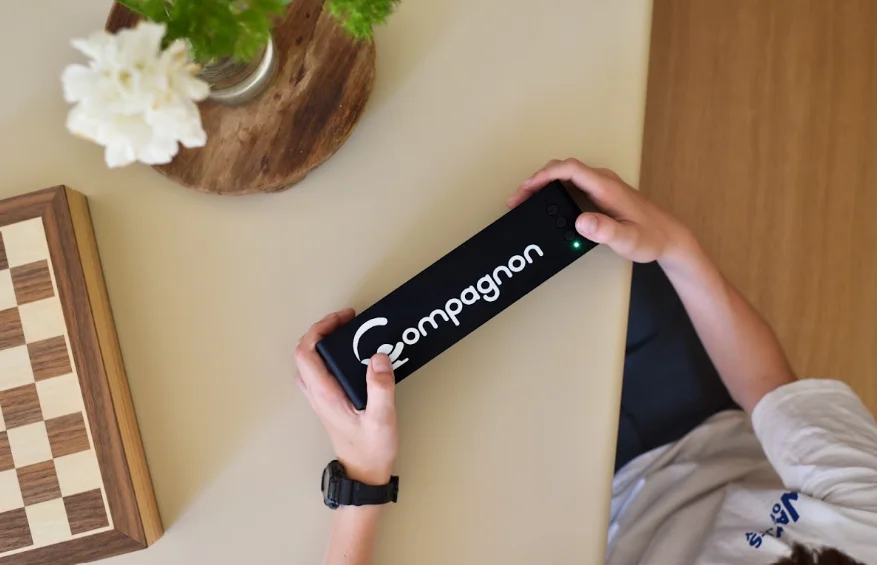
Compagnon takes over where the story box stops: at the moment the child wants to ask their own questions. The principle is as simple as a walkie-talkie: press the central button while asking your question, let go, and the answer comes.
The child chooses between three worlds depending on what they feel like. Exploring the world, for science, nature, history and inventions. School support, for maths, writing and foreign languages, with 97 languages to practice speaking. Relaxation, with audio stories to imagine, games and moments to unwind.
Two design choices clearly set it apart. Compagnon does not do the homework for the child: it explains, asks them to rephrase, quizzes them, but replaces neither the exercise book, nor written work, nor the teacher. And it is not designed as a buddy: its role is not to create an emotional bond, but to feed curiosity and encourage the child to explore on their own. That is precisely why it is called Compagnon.
How to choose, in practice
Rather than looking for the "best" device, it is better to start from your child: their age, what excites them, what your family needs day to day.
| Ary (Lookiz) | Mallow | Compagnon | |
|---|---|---|---|
| Age | 3-12 years | 4-10 years | 8-15 years |
| Format | Plush toy | Revealed at launch | Portable knowledge box |
| Core experience | Stories and conversation, by voice | Games where the child acts through voice | Exploring the world, homework and downtime, by voice |
| The ideal moment | Bedtime, the cuddly toy that tells stories | Learning through play | From the first "whys" to middle school |
For a toddler who falls asleep with their plush toy, Ary naturally extends the bedtime ritual. For a preschool or primary school child who loves to play and take on challenges, Mallow bets on adventure. For a child who asks questions all day long, who is entering the age of homework, presentations and revision, and whom you do not yet want to trust with a smartphone, Compagnon is designed for this specific period, and to support them all the way through middle school.
These devices are not in opposition. They tell the same story of change: a childhood that learns through voice, at every age with the tool that suits it.
What we are preparing when we answer a child who asks why
Children who are 8, 10 or 12 today will grow up in a world where we will talk more and more to the objects around us. So the real question is not whether they will have access to them, but how well prepared they will be.
For us, this is where the essential part lies. A child who has got into the habit of asking questions, listening to an explanation, rephrasing it, asking again when they have not understood, develops reflexes that will serve them all their life: curiosity, critical thinking, the ability to put their thoughts into words, the confidence to search on their own. All qualities that make free adults, able to keep learning and not settle for the first answer that comes along.
That is exactly the mindset we nurture at Compagnon. We believe every question deserves an answer: the big ones, the small ones, the funny ones, the impossible ones. That there is no limit to curiosity. And that the best way to help a child grow is to answer them the moment the question arises, rather than asking them to wait. Here, you are allowed to ask anything.
So the next time your child throws you a "why" at a moment when you have neither the time nor the answer, remember that it is not one question too many. It is the beginning of something. And their curiosity, too, deserves to be heard.