
Why do we celebrate Halloween? The true story of turnips, ghosts and Jack
Where did Halloween come from? From Celtic Samhain to Jack O’Lantern, discover the story of ghosts, turnips and pumpkins.
Every year on October 31st, pumpkins light up and children knock on doors. But where does this celebration, often thought of as American, really come from? Its story begins much further back, more than two thousand years ago, around a great fire. It passes through the Church, an Irish legend and a turnip. Here is how a Celtic night became Halloween.
Once upon a time, a night unlike any other
Let's travel back in time, long before sweets and skeleton costumes. We are among the Celts, who lived in what would become Ireland, Scotland and part of Gaul.
For them, the year wasn't divided like ours. It had two great halves: the light season and the dark season. And the passage from one to the other, around November 1st, was marked by a great festival: Samhain. It is often described as the Celtic New Year.
It was the end of the harvest. Herds came home, food was stored away, nights grew longer. And that's where the story becomes mysterious.
The Celts said that on the night of Samhain, the boundary between the world of the living and the world of the dead grew very thin. So thin that spirits could cross it and return, for one night, among the living.
So people lit great fires. And some disguised themselves, to blend in with the wandering spirits and go unnoticed.
You may have noticed: two ingredients of Halloween are already there. The night when anything is possible, and the costume.
When the Church gets involved
Centuries pass. Christianity spreads across Europe, and with it a new calendar of festivals.
In the 9th century, the Church set a great feast in honour of all the saints on November 1st: All Saints' Day. A little later, around the year 1000, Abbot Odilo of Cluny, in Burgundy, established a day dedicated to the dead on November 2nd. This is All Souls' Day, which still exists today.
Look at the dates: they fall exactly when Samhain used to be celebrated. The old festival of spirits and the new feast of the saints ended up side by side in the calendar.
And that's where the name comes from. In English, All Saints' Day was called "All Hallows' Day", the day of all the saints. The evening before was therefore "All Hallows' Eve". Say it quickly, several times in a row... and you get Halloween.
So Halloween is simply the eve of All Saints' Day.
Cakes in exchange for prayers
In the Middle Ages, in the British Isles, a custom took hold around All Saints' and All Souls' Day. The poorest people, and often children, went from door to door. They were given small cakes called "soul cakes". In return, they promised to pray for the household's departed.
In Scotland and Ireland, another tradition developed: people dressed up to go knocking on doors, and recited a song, a poem or a little joke to earn a piece of fruit, a treat or a coin.
Knocking on doors, dressing up, receiving something to eat: trick-or-treating was already being born.
The legend of Jack and his turnip
That leaves the question every child eventually asks: why a pumpkin?
To answer it, we need to tell the story of Jack, an old Irish legend.
Jack was a clever, stingy and not very honest man. It is said that he managed to trick the devil, not once but twice, and forced a promise out of him: never to come and claim his soul.
The day Jack died, things got complicated. Heaven refused to welcome such a disreputable man. And the devil, true to his promise, also refused to take him. Jack found himself stuck between the two worlds, doomed to wander through the night.
So that he could see a little, the devil threw him an ember. Jack slipped it into a turnip he had hollowed out. He became "Jack of the Lantern".
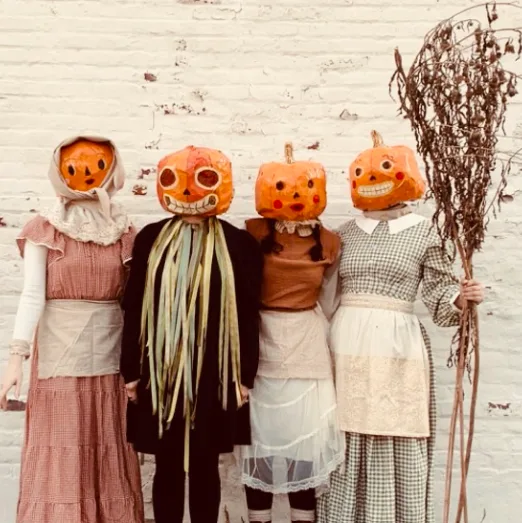
That's why, in Ireland and Scotland, people hollowed out turnips, and sometimes beets, carved frightening faces into them and placed a flame inside. They set them on windowsills to keep Jack and wandering spirits away.
Yes: the first Halloween lanterns were turnips.
The great journey to America
In the 19th century, Ireland suffered a terrible famine. Hundreds of thousands of Irish people left their country and crossed the ocean to settle in North America. They brought their traditions with them, and among them, Halloween.
Over there, a surprise awaited them: the pumpkin. Native to the Americas, it was everywhere in autumn, much bigger than a turnip and far easier to hollow out.
The turnip didn't stand a chance. The pumpkin became the official Halloween lantern.
It was also in North America, in the early 20th century, that the phrase "trick or treat" appeared. In France, it became "des bonbons ou un sort" (sweets or a spell). The soul cakes of the Middle Ages became sweets, and the prayers became playful threats.
And in France?
For a very long time in France, late October was mainly about All Saints' Day: chrysanthemums, visits to cemeteries, family meals.
Halloween as we know it only really took hold in France in the late 1990s. Shop windows filled with pumpkins, schools joined in, and children discovered trick-or-treating.
So it's a celebration that has made a strange journey: born in Europe, carried to America, then brought back to France, transformed, more than two thousand years after the first night of Samhain.
What this story teaches us today
This story deserves to be told as a family, and not only because it has ghosts in it.
First, it shows that our traditions have a history. What we do every year without thinking, dressing up, carving a pumpkin, knocking on doors, comes from very old gestures that were passed down, forgotten and transformed. Behind every "that's just how it is", there is almost always a why.
Next, it shows that cultures travel. A celebration can leave Ireland, cross an ocean with families looking for a better life, change vegetables along the way, and come back generations later in another form.
Finally, it reminds us that we have always needed to tell stories to tame what frightens us. The night, the coming winter, those who are gone. Yesterday as today, a little light, a few costumes and lots of laughter help us through the dark season.
That is exactly the spirit we try to nurture at Compagnon, the knowledge box designed for children aged 8 to 15. A child who asks "but why do we do this at Halloween?" isn't delaying trick-or-treating. They're pulling on a thread, and at the end of that thread lie two thousand years of history. With Compagnon, no question is too small or too strange: children can ask anything, independently and safely. Whether the question is about ghosts, the Celts, pumpkins or the legend of Jack, Compagnon answers, encourages curiosity and helps every child learn in their own way.
On October 31st, when your child asks you why we carve pumpkins, you'll have a story to tell. And this year, why not try an old-fashioned lantern, in a turnip? Just to see their face.