
How to Choose a Gift for a Child: 7 Tips That Last
Compagnon
How do you choose a gift a child will truly enjoy? Seven practical tips to find a thoughtful, age-appropriate present that lasts beyond the big reveal.
We all dream of the same gift. The one that makes a child's eyes light up as the wrapping paper tears. And the one that is still there two days later, once the excitement has settled, then two weeks later, then two months. The trouble is, they are not always the same gift. The good news is that researchers have looked into this, and their findings are rather reassuring. Here are our tips for choosing well.
At a glance
To choose a good gift for a child, think beyond the moment they open it. Studies show that gift-givers focus mainly on the surprise, while recipients value what will be useful to them over time. For children aged 8 to 15, a gift that lasts generally has three qualities: the child will still use it in a few months, they can use it independently, and it keeps offering them something as they grow. Price matters much less than we tend to think.
Why do some children's gifts fail to last?
Some gifts fail to last because they were chosen for the moment the child opens them, rather than the months that follow. It is a very common mistake, and research explains it well.
We all know that gift. On Christmas Eve, everyone is excited: it gets unwrapped, shown to the whole family and tried out straight away. Then, a few days later, it ends up at the back of a cupboard. Nobody quite got it wrong. But something did not hold up.
In December 2016, three American researchers, Jeff Galak of Carnegie Mellon University, and Julian Givi and Elanor Williams of Indiana University, published a review of the most common gift-giving mistakes in Current Directions in Psychological Science. Their conclusion comes down to one idea: the giver wants to impress and chooses a gift that can be enjoyed immediately, while the recipient mainly wants something that will benefit them over time. This research looks at gift-giving in general, both between adults and within families.
In other words, we often choose for the minute the wrapping comes off. The child, meanwhile, lives with the gift for months.
And between the ages of 8 and 15, there is another challenge: tastes change quickly. One passion follows another, starting secondary school reshapes their interests, and something they dreamed of in October may feel like “something for little kids” by February. Every parent sees this happen. A gift tied too closely to a trend or a one-off surprise is therefore likely to lose its appeal before winter is over.
So how do you find a gift that does both: shines on the big day and lasts afterwards?
7 tips for choosing the right gift for a child
To choose a gift that suits a child, start with what they genuinely want, imagine a few months down the line, and favour things they can use independently for a long time. Here are seven tips to help.
1. Think about March, not just 25 December. Before buying, picture the gift a few months later. Where will it be? Will your child still use it on a free afternoon or a weekday evening? If the answer is vague, that often points to a gift for the moment rather than one that lasts.
2. Take their wish list seriously. We sometimes feel that giving someone what they asked for lacks surprise. Research says otherwise. In 2011, Francesca Gino of Harvard and Francis Flynn of Stanford showed that people appreciate gifts they requested more than gifts chosen for them, even though givers tend to believe the opposite. A child who receives the thing they hoped for feels understood. That already means a lot.
3. Then listen to their questions. A wish list tells you what has caught a child's eye. Their questions tell you what truly interests them: how a volcano works, why we dream, who invented numbers, how to say “hello” in Japanese. If you want to add a personal touch alongside their list, that is where to look. A gift that feeds genuine curiosity has a long life ahead of it.
4. Do not confuse price with value. Francis Flynn and his colleagues also found that givers expect a more expensive gift to be better appreciated, while recipients do not appreciate a costly gift much more. For a child, a gift's value is mostly measured by how they use it. A small item they use every week is worth far more than a big present they never bring out again.
5. Choose a gift that grows with them. Between 8 and 15, a child moves from the middle years of primary school to the end of lower secondary school — from CE2 to troisième in the French school system. Their questions, interests and learning level change. Gifts that adapt to this development and offer more as they progress are the ones they keep for years.
6. Favour things they discover gradually. As Galak, Givi and Williams point out, givers favour things that can be enjoyed immediately, while recipients often like things that unfold over time. A subscription, a collection to build, an object with new possibilities to discover week after week: these gifts renew the pleasure instead of using it all up in one evening.
7. Think about what the gift will change at home. The best gifts do not only benefit the person receiving them. They spark conversations over dinner, “did you know…?” announcements in the living room, and shared moments. And if it is a connected device, check that it respects your household rules: genuine parental controls, no unrestricted Internet access, and parents who remain in charge.
The 3-question test before you buy
To work out whether a gift will last, ask yourself three questions before buying it. If you answer “yes” to all three, there is a good chance you have found the right one. This test works just as well for a book as for a board game, a musical instrument or an everyday object.
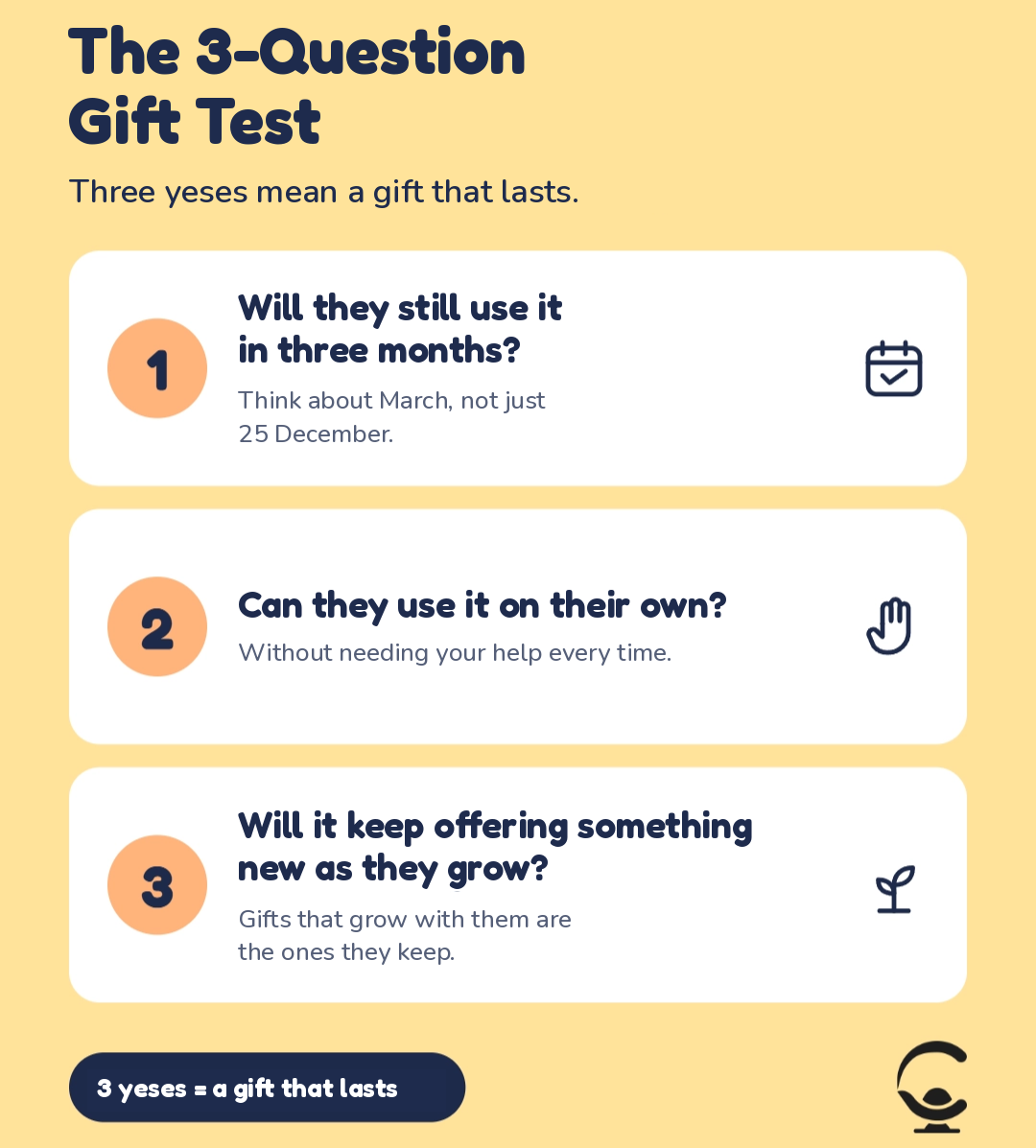
Three “yes” answers, and you have a gift that lasts.
What gifts should you give a child aged 8 to 15?
The gifts that last longest between 8 and 15 are those that nurture curiosity, a passion, independence or shared family moments. They have one thing in common: they keep giving the child something long after the day they first discover them.
Gifts that make them want to ask questions. A gift can be useful without feeling like schoolwork. It can make a child want to discover, understand and explore subjects they might never have thought about: stars, pharaohs, how the body works, where words come from. Between 8 and 15, curiosity is a powerful driving force. A gift that keeps it alive renews itself, because every answer brings another question.
Gifts that nurture a passion. Drawing materials for the child who fills every notebook with sketches, a racket for the one who talks about nothing but tennis, a factual book about space for the one asking about black holes. When a gift connects with an existing passion, it does not lose its appeal.
Gifts that encourage independence. Between 8 and 15, children want to do things on their own that they previously did with an adult: revise a lesson, find an answer, prepare a presentation. A gift that supports this need makes them proud, and that pride returns every time they use it.
Gifts to share. A cooperative board game, a family quiz, a book to read and then talk about together. These gifts last because they become part of shared memories.
If you are looking for specific ideas by age, our guide to choosing a gift for a grandchild aged 8 to 15 offers practical suggestions, from ages 8 to 10 through to adolescence. It was written with grandparents in mind, but its ideas work for anyone giving a gift.
What gift should you give a curious child aged 8 to 15?
For a curious child aged 8 to 15, an ideal gift answers their questions as they arise, helps them learn independently and evolves with them. That is exactly the idea we nurture at Compagnon.
Compagnon is an interactive, entirely voice-based knowledge box for children aged 8 to 15, designed and developed in France. It lets them freely ask questions aloud, discover new subjects and receive personalised support with all their homework, according to their age and profile, without a browser or unrestricted Internet access. It is the natural next step after story boxes: where a story box told stories and the child listened, Compagnon lets the child ask their own questions. To see how it differs from other devices in this family, read our overview of the new generation of story boxes.
Compagnon meets all three questions in our test quite naturally.
It is still useful in three months, and long afterwards. A child's questions never stop. There are the ones that arise during homework, the ones at snack time, and the ones they do not dare ask in class. Compagnon supports children with all their questions and homework, from science and history to maths, writing, and speaking practice in 97 languages.
The child uses it independently. They press the button, ask their question, and the answer comes. Compagnon explains, asks them to rephrase, and asks questions in return, but never does the work for them. The child understands, moves forward and gains confidence.
It grows with them. At 8, it is quizzes, stories and questions about animals and countries. In lower secondary school, it is revising a lesson or preparing for a test. As a teenager, it is preparing a presentation or making sense of current affairs.
And for parents, the boundaries are clear: no advertising, no browser, no social media. From their phone, they create the child's profile, choose permitted usage times and remain in control of the questions asked. Sensitive questions are immediately referred to an adult. Compagnon uses the home's Wi-Fi, where it naturally finds its place.
Frequently asked questions
How do you choose a gift for a child?
To choose a gift for a child, start with something they genuinely want, expressed in their wish list or through their questions, and check that it will remain useful beyond the day they open it. Three questions can help you decide: will they still use it in three months, can they use it independently, and will the gift evolve with them?
How do you choose a Christmas gift for a child?
At Christmas, it is tempting to focus on the surprise when the presents are opened. Yet research shows that recipients mainly appreciate gifts that remain useful over time. It is therefore better to choose something they will still use in March than a spectacular present they will forget in January.
Should you give a child what they asked for?
Usually, yes. A study by Francesca Gino and Francis Flynn published in 2011 shows that people appreciate gifts they requested more than ones chosen for them. You can still add a personal touch inspired by whatever the child is passionate about at the moment.
What is an original gift for a 10-year-old?
An original gift for a 10-year-old is often something beyond a conventional toy that feeds their curiosity: an object to explore a passion, discover a new subject or learn a language. At this age, children also like gifts that let them manage on their own, like older children.
What makes a gift last?
A gift that lasts is one the child keeps using weeks or months after receiving it. It feeds their curiosity or a passion, encourages independence, can be shared as a family, or adapts to their age. By contrast, a gift chosen solely for its surprise factor often loses its appeal quickly.
Does an expensive gift bring more joy?
Not necessarily. Research by Francis Flynn and his colleagues at Stanford shows that givers overestimate the importance of price: recipients do not appreciate a costly gift much more. For a child, what matters is how they will use it.
What is Compagnon?
Compagnon is an interactive, entirely voice-based knowledge box for children aged 8 to 15, designed and developed in France. Children freely ask their questions aloud, discover new subjects and receive personalised support with all their homework. Compagnon works without advertising or a browser, with parental controls managed from the parents' phone.
The best gift makes them want to ask questions
Ultimately, the gift that makes a child's eyes light up and the one that lasts are not so far apart. What makes a child shine is not just the surprise. It is the feeling of being understood, of receiving something that feels right for them and will stay with them.
So this year, before choosing, watch your child ask questions. The “why?” over breakfast, the “how does it work?” on the way home from school, the “did you know…?” at dinner. That is where you will find the gift that lasts far longer than two days.
What if the best gift were the one that makes them want to ask more and more questions… and answers every one?
Sources
- Jeff Galak, Julian Givi and Elanor F. Williams, “Why Certain Gifts Are Great to Give but Not to Get: A Framework for Understanding Errors in Gift Giving”, Current Directions in Psychological Science, vol. 25, no. 6, December 2016. doi.org/10.1177/0963721416656937
- Francesca Gino and Francis J. Flynn, “Give them what they want: The benefits of explicitness in gift exchange”, Journal of Experimental Social Psychology, 2011.
- Stanford Graduate School of Business, “Give Them the Gift They're Expecting”, 15 September 2011, overview of Francis Flynn's research on requested gifts and gift prices. gsb.stanford.edu