
November 11 Explained to Kids: The 1918 Armistice
Marie de Longvilliers
Explain November 11 to children through the 1918 Armistice, the railway carriage at Compiègne, and the story of the Unknown Soldier.
Every year on November 11, there is no school in France. Flowers are laid at the war memorial, a minute of silence is observed, and some people wear a little cornflower in their buttonhole. But why this date, and not another? Behind this public holiday lies a railway carriage hidden deep in a forest, six hours that nobody ever forgot, and a young soldier who had to make the most difficult decision of his life using simple addition. Here is the true story of November 11, to share as a family.
A railway carriage, a forest, and a signature at 5:15 a.m.
The year is November 1918. For over four years, the First World War has pitted France and its allies against Germany. Millions of soldiers have lived in the trenches, in the mud and cold. In France, they are called the poilus.
That autumn, Germany is exhausted. It asks to negotiate an end to the fighting. The chosen location is unexpected: a clearing in the middle of the Compiègne Forest, near the village of Rethondes, in the Oise department. No palace, no grand drawing room. Just a train, parked on a railway track surrounded by trees.
It is the train of Marshal Foch, commander-in-chief of the Allied armies. One of its carriages, a former dining car converted into an office, bears the number 2419D. That is where everything will be decided.
Throughout the night of November 10 to 11, the 34 articles of the agreement are read through and discussed. And on November 11, 1918, at 5:15 in the morning, the German representatives sign the armistice.
An armistice is not quite peace yet. It is an agreement to cease fighting. Permanent peace would be signed later, at Versailles, on June 28, 1919.
Six hours too many
The armistice is signed at 5:15 a.m. You might think the war came to a halt that very minute. It did not.
High command decides that weapons will fall silent at 11 o'clock sharp. The eleventh hour of the eleventh day of the eleventh month: a symbolic time, and one that allowed enough time to notify all troops across hundreds of kilometers of front lines.
Yet during those six hours, fighting goes on.
In Vrigne-Meuse, in the Ardennes, a 40-year-old soldier runs to deliver a message to his captain. His name is Augustin Trébuchon. Before the war, he was a shepherd in Lozère. He survived Verdun, the Chemin des Dames, and the Marne. At 10:50 a.m., he is struck by a bullet. He is the last French soldier killed in action during the Great War. On the American side, 23-year-old Henry Gunther falls at 10:59 a.m. One minute before the end.
After the war, something peculiar was done: on the death certificates and headstones of certain French soldiers who died that day, the date recorded was November 10. As if dying on the very day of victory was too painful to write down. On Augustin Trébuchon's grave, you can still read “November 10, 1918”.
11 o'clock: the bugles, then the bells
At 11 o'clock sharp, all along the front line, buglers leap onto the parapets of the trenches and sound the ceasefire. In Vrigne-Meuse, right where Augustin Trébuchon had just fallen, Octave Delaluque, a bugler from his regiment, sounds the final notes.
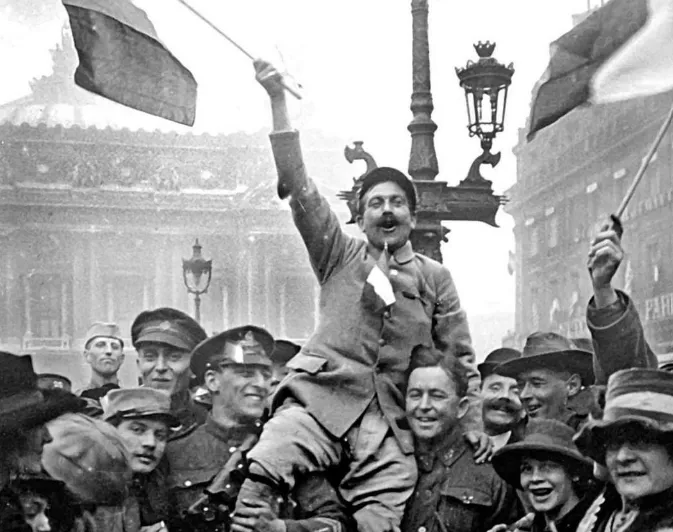
And all across France, at that very same moment, church bells begin to chime joyfully. In villages, people spill out into the streets. Some sing, others weep. Many do both.
Imagine the sound: thousands of church belltowers ringing in unison from one end of the country to the other. That was how many people in France found out the war was finally over.
The railway carriage used twice
Carriage 2419D became a symbol. But its story did not end there, and it took a strange turn.
Twenty-two years later, in 1940, France lost a battle against Hitler's Germany. Hitler demanded that France sign its surrender… inside the very same carriage, placed in the exact same spot as in 1918. On June 22, 1940, it took place. The carriage was then taken to Germany, where it was destroyed in 1945.
Today, in the Rethondes clearing, you can step inside an identical carriage, on display since 1950 at the Armistice Memorial. It is not the original, but it is its perfect twin.
As you can see: a single object can carry an immensely heavy history. And sometimes, twice over.
Eight coffins and an addition
After the war, a question haunted families. Hundreds of thousands of soldiers died without ever being identified. Their relatives had no grave to visit to grieve. How could they be honored?
An idea emerged: choose one unknown soldier, just one, who would represent all the others.
On November 10, 1920, inside the citadel of Verdun, eight coffins were lined up. Each contained the body of an unidentified soldier brought from a different sector of the front. They had been moved several times so that nobody could know where each one came from.
Now, someone had to choose. That duty fell to a 21-year-old soldier, Auguste Thin. He had volunteered to enlist, had been wounded and gassed at the front, and his father had gone missing during the war. He was handed a bouquet of flowers: he was to place it on one of the coffins.
How do you choose when all the coffins look alike?
Auguste Thin later recounted what went through his mind. He belonged to the 6th Army Corps. His regiment was the 132nd. He added the digits together: 1 + 3 + 2 = 6. Another 6. His mind was made up: it would be the sixth coffin.
He laid down his bouquet, stood at attention. The Unknown Soldier had been chosen.
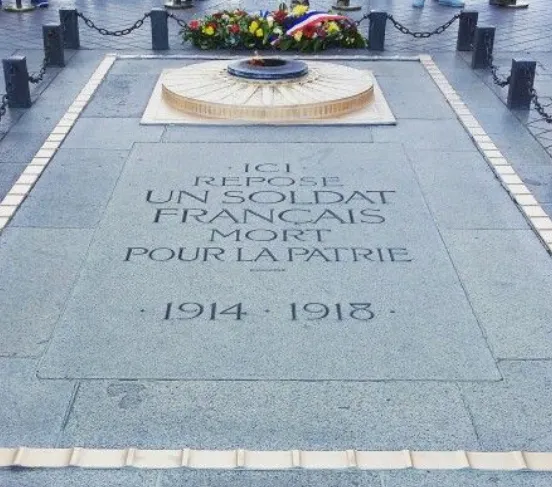
The coffin was taken by train to Paris. On November 11, 1920, it passed beneath the Arc de Triomphe. He was buried there on January 28, 1921, where he rests to this day.
A flame that never goes out
Sometime later, a journalist named Gabriel Boissy was walking home late at night and passed by the grave. It struck him as terribly lonely in the dark. He suggested keeping a permanent flame burning there.
On November 11, 1923, at 6:00 p.m., the flame was lit for the very first time by government minister André Maginot. Since then, it has never gone out.
Every evening at 6:30 p.m., war veterans and associations rekindle it during a short ceremony. Every single evening, without exception. Even on June 14, 1940, the day the German army marched into Paris, the ceremony was held. The ceremony is open to everyone and free of charge.
Why a cornflower?
On November 11 in France, you might have noticed people wearing a small blue fabric flower. This is the Bleuet de France (the French cornflower).
Why this particular flower? Because cornflowers continued to grow in the soil churned up by artillery shells, where nothing else could grow. And because the young recruits who arrived at the front in 1915, in their brand-new "horizon blue" uniforms, were nicknamed “the cornflowers” (les bleuets).
The idea for the fabric flower came from two women at the Invalides military hospital in Paris: nurse Suzanne Lenhardt and Charlotte Malleterre. They organized workshops where severely wounded soldiers crafted cornflowers. The flowers were sold, and the funds helped them make a living and rediscover the dignity of work. A century later, cornflowers are still sold around November 11 to support veterans and victims of war.
In the United Kingdom and Canada, people wear a different flower for the same reason: the poppy.
What we are truly commemorating on November 11
November 11 became an official French public holiday in 1922, designated by law as the day of victory and peace.
Since 2012, the date has taken on a broader meaning: on November 11, France pays tribute to all those who “died for France” (morts pour la France), civilians and military personnel alike, across all conflicts, past and present. That is why, in your local town, the ceremony at the war memorial sometimes includes names that are far more recent than 1918.
It is not a holiday in the celebratory sense of the word. It is a day to remember, and to say thank you.
How to talk about it with your child aged 8 to 15
Start with what is close to home. Nearly every town and village in France has its own war memorial. Go see it together, read a few names out loud. Children are often struck when they spot the same family name repeated multiple times: brothers, cousins, all departed from the very same village.
Look for a poilu in your family tree. Ask grandparents if they remember an ancestor who went off to war. The French Ministry of the Armed Forces' public database, Mémoire des hommes, lets you search records of soldiers who died for France by name. That is often the moment history becomes personal.
Tell a story first, not a lecture. The railway carriage, Auguste Thin's addition, the church bells all ringing at the same moment: these are vivid images an 8-year-old can hold onto. The dates can come later. Great true stories, like that of the doctor who saved thousands of lives simply by washing his hands, always work better than a dry summary.
Make room for tough questions. “Why did they keep fighting until 11 o'clock?” “Why did they change the date on the graves?” These questions do not always have simple answers, and that is just fine. Saying “I don't know, let's look it up together” already teaches them how to think critically.
Connect it to what they are learning in school. The First World War is covered in CM2 (Year 6, age 10-11), and again in 3e (Year 10, age 14-15, French middle school). If that is on the syllabus this year, November 11 is a wonderful opportunity to revisit the lesson from a different angle: our tips on how to study a lesson effectively and how to support homework help at home can come in handy.
Turn it into a game. At the dinner table, start a mini quiz: What time was the armistice signed? Which coffin did Auguste Thin choose? Why a cornflower? For more ideas, our general knowledge quiz for 8-12 year-olds is a great starting point.
What this story teaches us today
November 11 can feel like a rigid date, made of formal speeches and solemn silence. Yet it is a story full of real life.
First, it shows that behind every major historical event, there are individuals: a shepherd from Lozère, a bugler, a young soldier holding a bouquet, two nurses, a journalist walking home late. History with a capital H is made up of all these smaller stories.
Next, it shows that symbols always have an origin. A flame, a flower, a specific hour: nothing is there by chance. Just like Halloween and its turnips, every date on the calendar hides a reason why.
Finally, it reminds us that remembering is an active choice. A flame kept alive every single evening for over a hundred years does not burn on its own. It endures because people choose, day after day, not to forget.
That is precisely the spirit we strive to nurture at Compagnon, the knowledge box designed for children aged 8 to 15. When a child asks, “Why do we have no school on November 11?”, they have just opened the door to an immense chapter of history. With Compagnon, no question is ever too small or too challenging: kids are free to ask anything, with complete independence and in total safety. Whether they want to understand what an armistice is, why people wear a cornflower, or how the poilus survived in the trenches, Compagnon answers, sparks their curiosity, and helps them learn at their own pace.
On Wednesday, whether at the war memorial or around the dinner table, you will have a story to share with them. Start with Auguste Thin's addition. Chances are, they will ask you what happened next.